

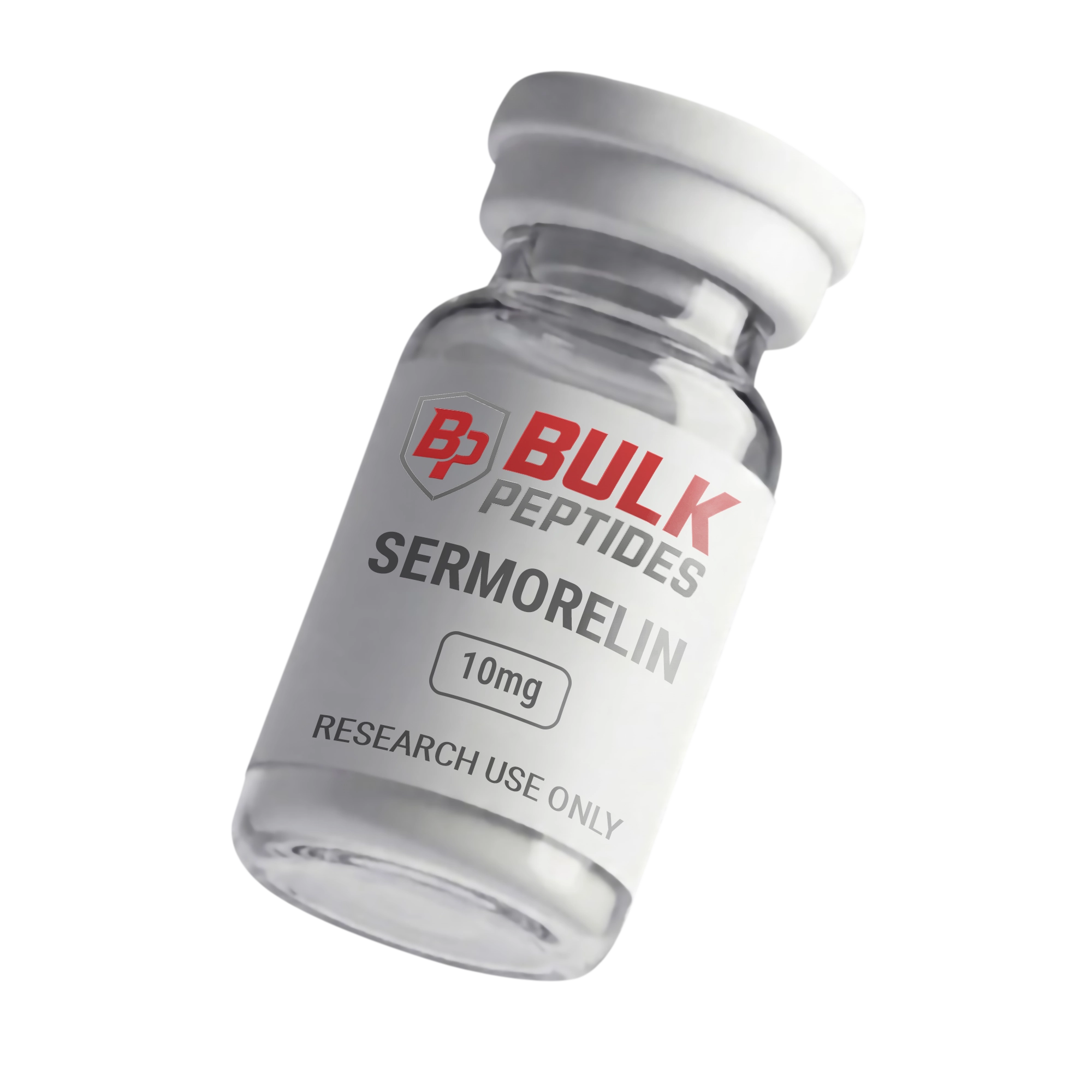
Sermorelin
Sermorelin is a synthetic peptide analogue of the Growth Hormone-Releasing Hormone (GHRH). It consists of the first 29 amino acids (GRF 1-29) of the endogenous 44-amino acid GHRH sequence. Research indicates that this truncated fragment retains full biological activity relative to the full-length hormone, specifically stimulating the pituitary gland to secrete growth hormone in a pulsatile manner. For Research Use Only. Not for human consumption.
Sermorelin possesses the molecular formula C₁₄₉H₂₄₆N₄₄O₄₂S. It represents the amino-terminal fragment of the native growth hormone-releasing hormone (GHRH). Structural analysis reveals that the first 29 amino acids of the GHRH sequence are responsible for the specific binding to pituitary receptors, making Sermorelin functionally equipotent to the full-length GHRH(1-44) in laboratory assays.
Scientific studies investigate the interaction between Sermorelin and the GHRH receptor on the surface of somatotroph cells. Upon binding, the peptide activates the adenylate cyclase signaling pathway, increasing intracellular cAMP levels. This cascade results in the transcription and secretion of growth hormone. Unlike synthetic secretagogues that bypass regulatory feedback loops, Sermorelin is used to study physiological control mechanisms where negative feedback from Somatostatin remains active.
In animal models, Sermorelin is utilized to examine the effects of restored growth hormone pulsatility on tissue repair and metabolism. Researchers also investigate its stability profile; while it has a short biological half-life compared to modified analogues like CJC-1295, its rapid clearance makes it a precise tool for studying acute pituitary responses and circadian rhythm regulation regarding hormone secretion.
This product is strictly for laboratory and research purposes only. Sermorelin is not intended for human use, diagnostic, or therapeutic procedures. It serves as a reagent for scientific study and method development.
References
- Campbell, R. M., et al. (1991). “ORF 1-29 amide is a potent secretagogue for growth hormone in the rat.” Peptides, 12(3), 569-574.
- Gereben, B., et al. (1994). “Agonist-induced desensitization of the growth hormone-releasing hormone (GHRH) receptor.” Molecular and Cellular Endocrinology, 106(1), 13-19.
- Walker, R. F., et al. (1994). “Pharmacokinetics and pharmacodynamics of a sustained release formulation of sermorelin (GHRH 1-29) in rats.” Pharmaceutical Research, 11, 14-19.