

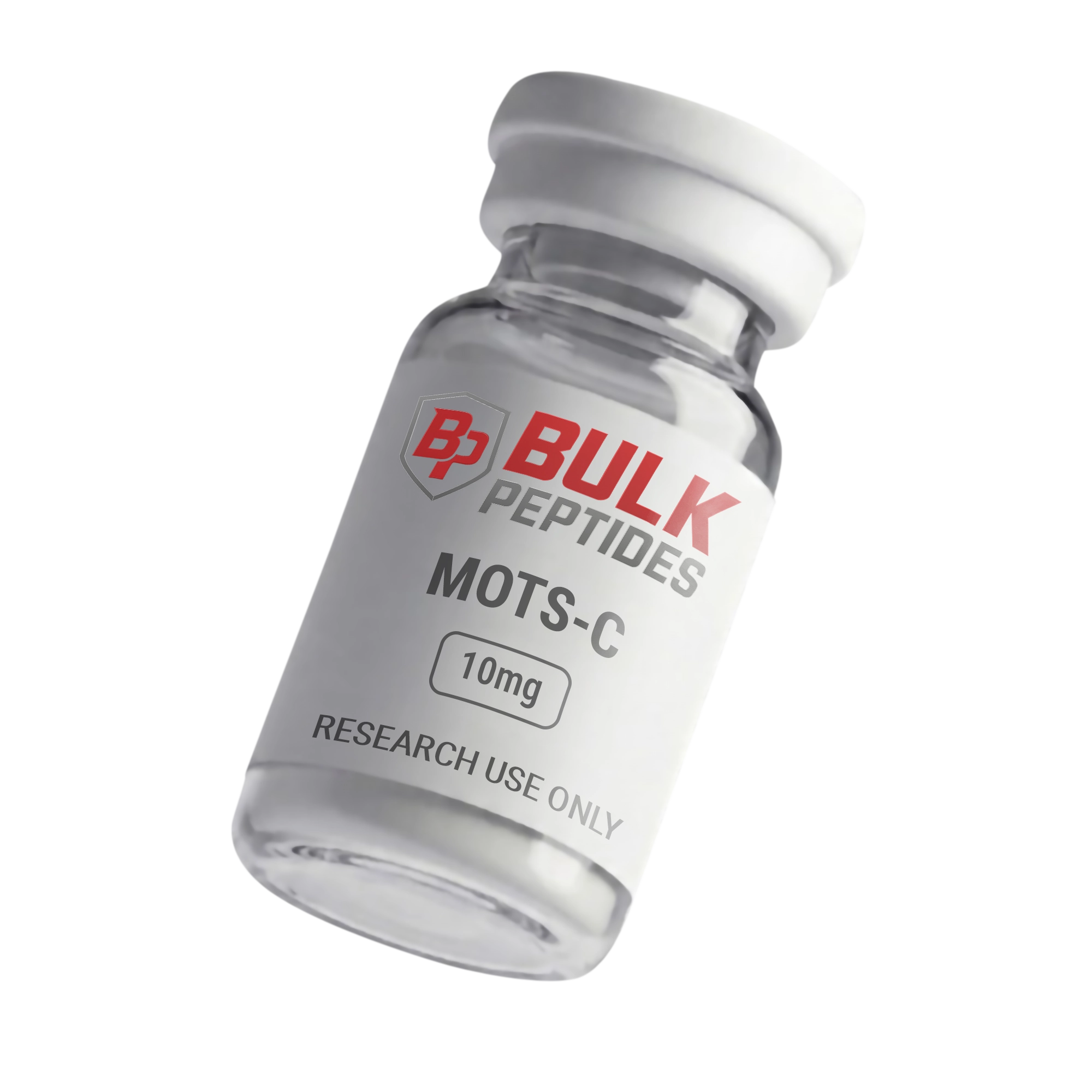
MOTS-C
MOTS-c (Mitochondrial Open Reading Frame of the 12S rRNA-c) is a synthetic peptide consisting of 16 amino acids. Unlike nuclear-encoded peptides, MOTS-c is derived from the mitochondrial genome. Research investigates its role as a signaling molecule that regulates metabolic homeostasis, specifically focusing on its interaction with the folate cycle and the activation of the AMP-activated protein kinase (AMPK) pathway. For Research Use Only. Not for human consumption.
MOTS-c possesses the molecular formula C₁₀₁H₁₅₂N₂₈O₂₂S₂. It is a unique peptide encoded within the mitochondrial 12S rRNA gene, a region previously thought to be non-coding. Structural analysis confirms it is a 16-amino acid sequence that translocates from the mitochondria to the nucleus in response to metabolic stress. This translocation allows researchers to study mitochondrial-nuclear communication, a process essential for cellular adaptation to energy demands.
Scientific studies focus on the peptide’s ability to target the methionine-folate cycle. By inhibiting the folate cycle at the level of 5-methyltetrahydrofolate, MOTS-c increases the cellular pool of 5-aminoimidazole-4-carboxamide ribonucleotide (AICAR). This accumulation leads to the activation of AMP-activated protein kinase (AMPK), a master regulator of cellular energy homeostasis. In laboratory models, this pathway is investigated for its resemblance to the effects of caloric restriction and exercise.
In murine models of diet-induced obesity, MOTS-c administration has been observed to prevent age-dependent and high-fat-diet-induced insulin resistance. Researchers utilize this peptide to examine glucose metabolism and fatty acid oxidation in skeletal muscle tissue. Data suggests that MOTS-c may enhance glucose utilization and insulin sensitivity, leading to its classification in some literature as a potential “exercise mimetic” for research purposes.
This product is strictly for laboratory and research purposes only. MOTS-c is not intended for human use, diagnostic, or therapeutic procedures. It serves as a reagent for scientific study and method development.
References
- Lee, C., et al. (2015). “The mitochondrial-derived peptide MOTS-c promotes metabolic homeostasis and reduces obesity and insulin resistance.” Cell Metabolism, 21(3), 443-454.
- Kim, K. H., et al. (2018). “The mitochondrial-derived peptide MOTS-c: A player in metabolic regulation.” Journal of Endocrinology, 238(2), R1-R7.
- Reynolds, J. C., et al. (2021). “Mitochondrial-derived peptides: New regulators of metabolism.” Experimental Physiology, 106(1), 10-17.