

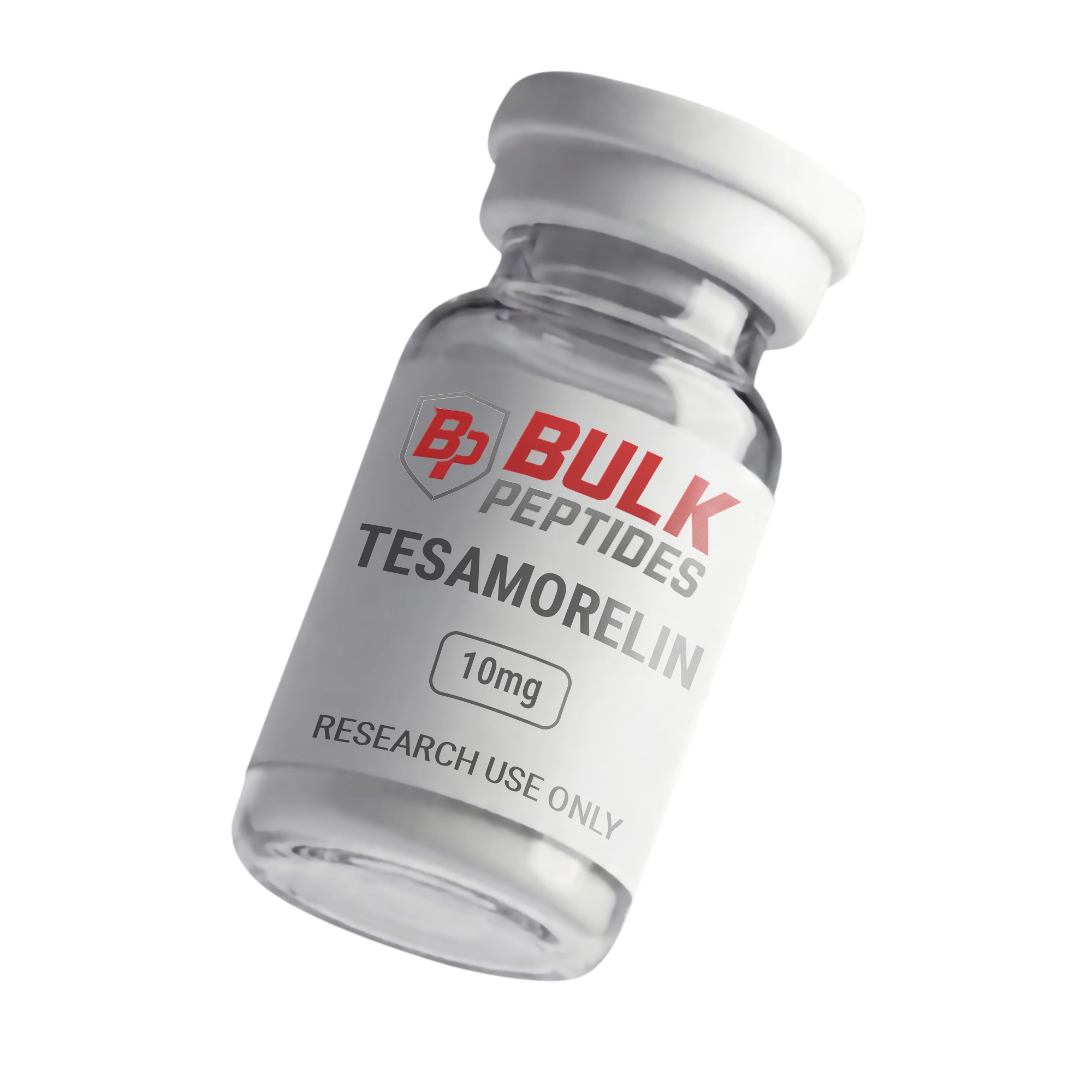
Tesamorelin
Tesamorelin is a synthetic peptide consisting of 44 amino acids. It is a stabilized analogue of the Growth Hormone-Releasing Hormone (GHRH), distinguished by the addition of a trans-3-hexenoic acid group at the N-terminus. Research investigates this modification for its ability to extend the peptide's stability and biological half-life while retaining affinity for GHRH receptors in the anterior pituitary. For Research Use Only. Not for human consumption.
Tesamorelin possesses the molecular formula C₂₂₁H₃₆₆N₇₂O₆₇S. It is chemically identified as a trans-3-hexenoyl modification of the human Growth Hormone-Releasing Factor (hGRF) comprising the full 44 amino acid sequence. This N-terminal modification is designed to resist enzymatic degradation by dipeptidyl peptidase-IV (DPP-IV), a primary factor in the rapid breakdown of endogenous GHRH in laboratory environments.
Scientific studies focus on the interaction between Tesamorelin and the GHRH receptors located on somatotrophs in the anterior pituitary gland. Upon binding, the peptide is observed to stimulate the synthesis and pulsatile release of endogenous growth hormone. Unlike non-pulsatile analogues, Tesamorelin is used in research to mimic physiological secretion patterns and evaluate downstream effects on Insulin-Like Growth Factor 1 (IGF-1) levels.
A significant area of investigation involves the metabolic effects of Tesamorelin in animal models, particularly regarding lipid metabolism. Researchers utilize this peptide to study the reduction of visceral adipose tissue and the mechanisms of lipolysis. Data suggests that the administration of Tesamorelin may influence hepatic fat content and triglyceride levels, providing a model for understanding metabolic dysregulation and visceral fat accumulation.
This product is strictly for laboratory and research purposes only. Tesamorelin is not intended for human use, diagnostic, or therapeutic procedures. It serves as a reagent for scientific study and method development.
References
- Ferdinandi, E. S., et al. (2007). “Preclinical pharmacokinetics and metabolism of TH9507, a growth hormone-releasing factor analog, in mice, rats, dogs, and monkeys.” Journal of Endocrinology, 195(1), 1-14.
- Makimura, H., et al. (2013). “Reduced growth hormone secretion is associated with increased visceral adiposity in healthy older adults.” The Journal of Clinical Endocrinology & Metabolism, 98(5), 2090-2097.
- Stanley, T. L., et al. (2011). “Effects of a growth hormone-releasing hormone analog on endogenous GH pulsatility and insulin sensitivity in healthy men.” The Journal of Clinical Endocrinology & Metabolism, 96(1), 150-158.