Research Support Compounds
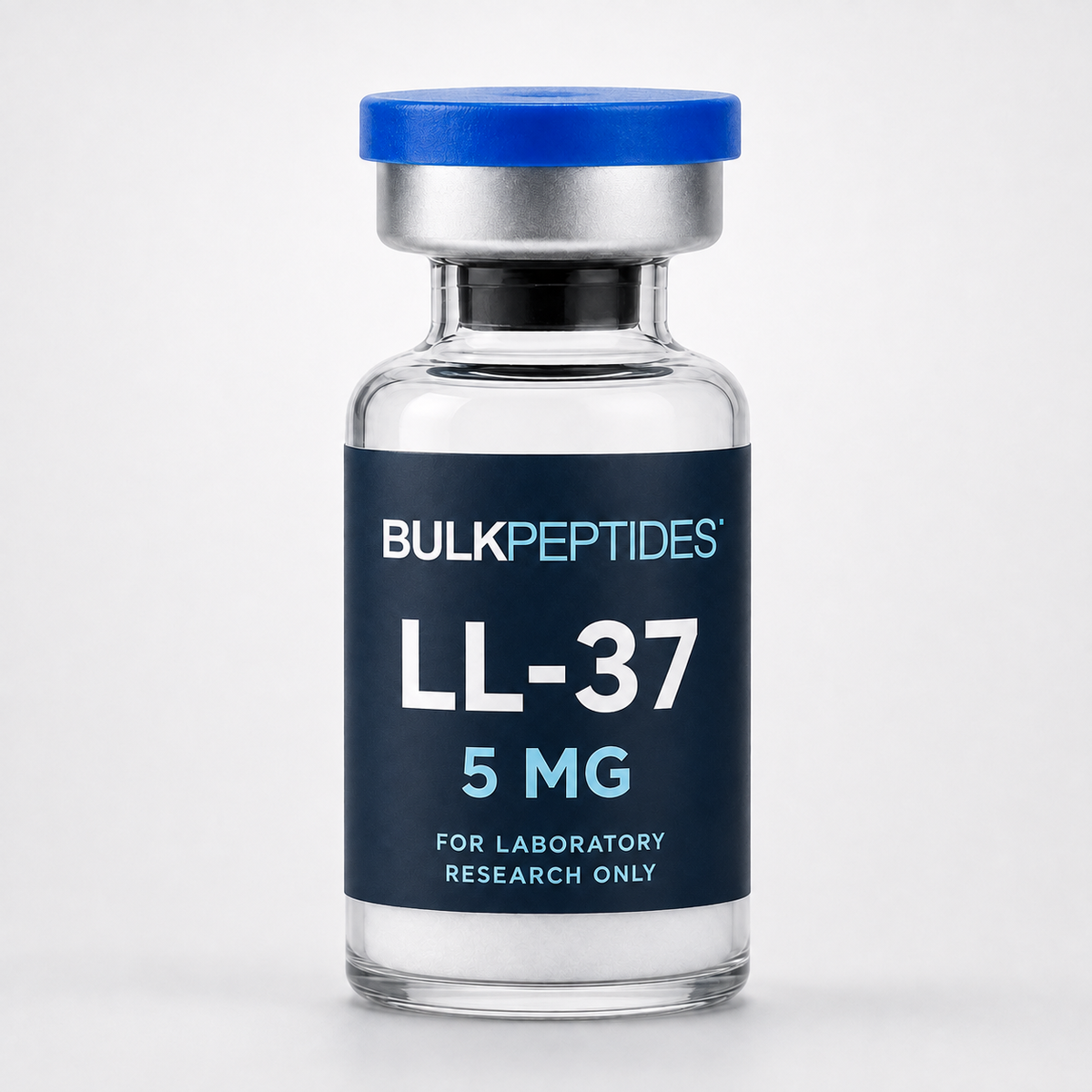
LL-37
Available
Volume savings
Automatic discounts across eligible products and sizes.
- 2+ items5% off
- 3+ items10% off
- 5+ items15% off
- 10+ items20% off
Savings apply automatically in your cart.
Offer details
Mix eligible products and sizes, including Retatrutide vials. Items already in your cart count toward your discount. View cart.
SKU:
Supplied for laboratory research and development. Not for human or veterinary use, consumption, or clinical applications.
Product information
About LL-37
LL-37 Research Peptide
Explore LL-37 from the Bulk Peptides research catalog. This peptide is offered for qualified laboratory work; compare the available presentation with the identity and documentation requirements of your project.
Product information
Select from the presentations shown on this page. For a specific batch or analytical requirement, contact [email protected] for available product documentation before ordering.
For laboratory research use only. Not for human or veterinary use, diagnosis, treatment, or clinical application.
Product research information
LL-37 is a synthetic peptide with the molecular formula C₂₀₅H₃₄₀N₆₀O₅₃. It corresponds to the C-terminal sequence of the endogenous human cathelicidin antimicrobial protein (hCAP18). In aqueous laboratory environments, the peptide adopts a highly amphipathic alpha-helical structure. This distinct conformation is critical for its biological activity, as it allows the peptide to seamlessly interface with the lipid bilayers of cellular membranes.
Scientific studies focus extensively on the peptide’s ability to selectively disrupt microbial membranes. Driven by its net positive charge (cationic nature), LL-37 binds to the negatively charged surface molecules of various pathogens. In vitro assays demonstrate that this interaction leads to the formation of transmembrane pores and subsequent cell lysis. Researchers utilize this mechanism to study the innate immune system’s initial defense response against bacterial, viral, and fungal agents independently of traditional antibiotic pathways.
Beyond its direct antimicrobial activity, LL-37 is investigated for its complex immunomodulatory signaling. In cellular models, the peptide has been observed to neutralize endotoxins such as lipopolysaccharides (LPS), thereby downregulating the release of pro-inflammatory cytokines and mitigating hyper-inflammatory responses. Furthermore, researchers examine its role in extracellular matrix remodeling and angiogenesis, utilizing murine models to understand how host defense peptides may accelerate epithelial cell migration and wound closure under induced metabolic stress.
References
- Scott, M. G., et al. (2002). “The human antimicrobial peptide LL-37 is a multifunctional modulator of innate immune responses.” The Journal of Immunology, 169(7), 3883-3891.
- Dürr, U. H., et al. (2006). “LL-37, the only human member of the cathelicidin family of antimicrobial peptides.” Biochimica et Biophysica Acta (BBA)-Biomembranes, 1758(9), 1408-1425.
- Nijnik, A., & Hancock, R. E. (2009). “The roles of cathelicidin LL-37 in immune defences and novel clinical applications.” Current Opinion in Hematology, 16(1), 41-47.
Need help with product information?
Our team can help with available formats, bulk quantities, and documentation requests.