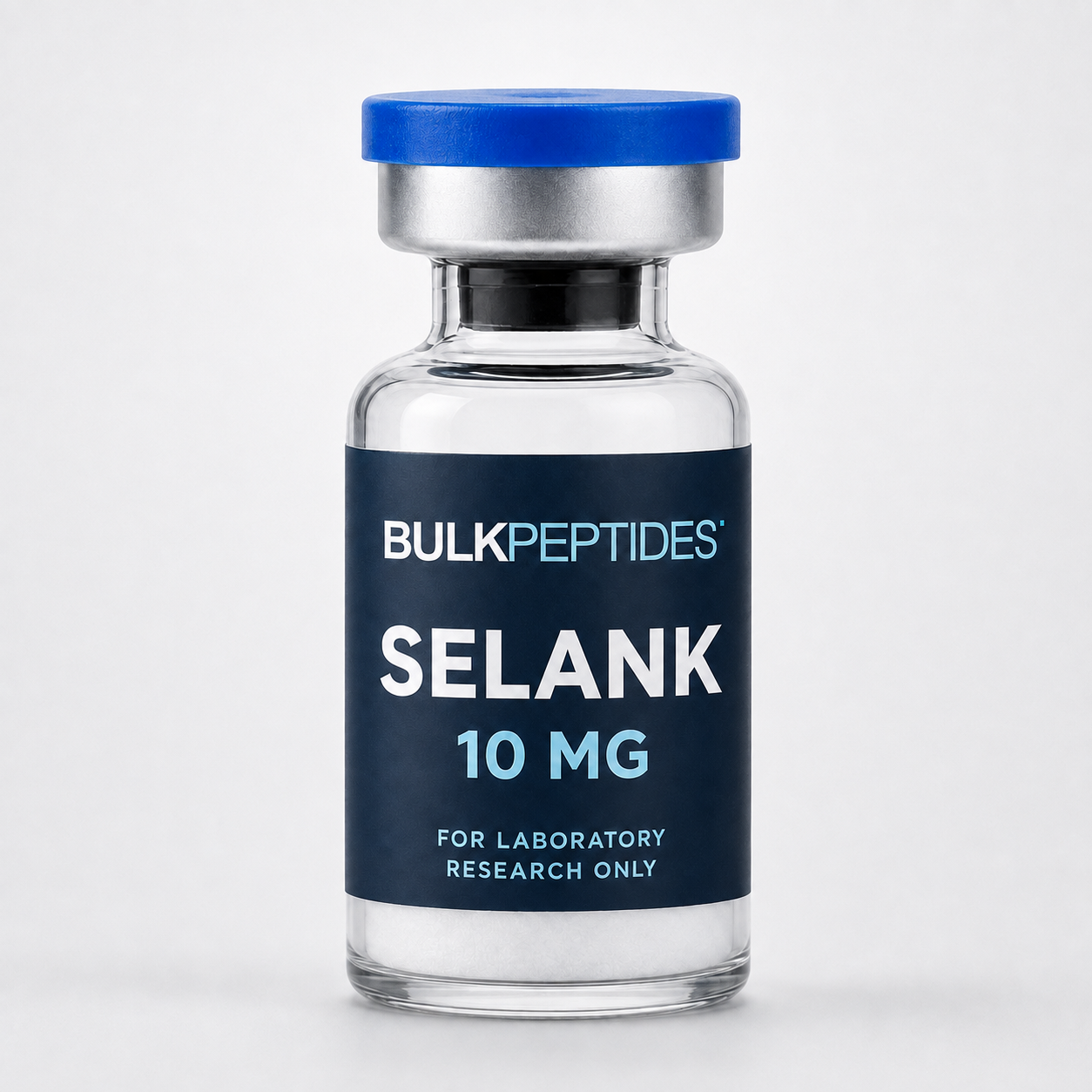
Bioactive Research Peptides
Selank
Available
Volume savings
Automatic discounts across eligible products and sizes.
- 2+ items5% off
- 3+ items10% off
- 5+ items15% off
- 10+ items20% off
Savings apply automatically in your cart.
Offer details
Mix eligible products and sizes, including Retatrutide vials. Items already in your cart count toward your discount. View cart.
SKU: SELANK10MG
Supplied for laboratory research and development. Not for human or veterinary use, consumption, or clinical applications.
Product information
About Selank
Selank Research Peptide
Selank is offered as a peptide material for qualified laboratory research. Compare the available presentation and product information, and use the research library for a referenced overview of the compound and its evidence limits.
Product information
Select from the presentations shown on this page. For a specific batch or analytical requirement, contact [email protected] for available product documentation before ordering.
Read the Selank research guide
For laboratory research use only. Not for human or veterinary use, diagnosis, treatment, or clinical application.
Product research information
Product Specifications
- Chemical Name: Selank (TP-7)
- CAS Number: 129954-34-3
- Molecular Formula: C₃₃H₅₇N₁₁O₉
- Molecular Weight: 751.9 g/mol
- Sequence: Thr-Lys-Pro-Arg-Pro-Gly-Pro
- Analytical results: Review documentation for the exact supplied lot.
- Form: Lyophilized White Powder
- Solubility: Soluble in bacteriostatic water or sterile water
Selank is a synthetic peptide with the molecular formula C₃₃H₅₇N₁₁O₉. It is structurally composed of the tetrapeptide Tuftsin (Thr-Lys-Pro-Arg) with the addition of a Pro-Gly-Pro sequence at the C-terminus. This structural modification is hypothesized to improve the metabolic stability of the peptide in biological mediums compared to endogenous ligands.
Scientific investigations have focused on Selank’s ability to modulate the expression of Brain-Derived Neurotrophic Factor (BDNF) in the hippocampus of murine models. Furthermore, studies suggest that the peptide may inhibit the enzymatic degradation of enkephalins, which are endogenous peptides involved in nociception and stress response. This inhibition is believed to extend the half-life of these regulatory molecules within the nervous system.
In behavioral research utilizing rat models, Selank has been observed to affect dopamine and serotonin turnover rates in the frontal cortex. Researchers explore these pathways to understand potential mechanisms related to anxiety-like behavior, memory retention, and learning processes. The peptide is also subject to studies regarding its immunomodulatory properties due to its Tuftsin lineage.
References
- Semenova, T. P., et al. (2010). “Comparison of the effects of selank and tuftsin on the metabolism of serotonin, dopamine, and norepinephrine in the brain of mice with different phenotypes of emotional and behavioral reactions.” Neuroscience and Behavioral Physiology, 40(9), 1007-1012.
- Kozlovskaya, M. M., et al. (2003). “Selank and short peptides of the tuftsin family in the regulation of adaptive behavior in stress.” Neuroscience and Behavioral Physiology, 33(9), 853-860.
- Ushakova, V. M., et al. (2017). “Gene expression in the hippocampus of rats with different variants of behavior in the elevated plus-maze test under basal conditions and after administration of the peptide selank.” Russian Journal of Genetics, 53(2), 239-246.
Need help with product information?
Our team can help with available formats, bulk quantities, and documentation requests.